How to Knit the Long Tail Cast On

The long tail cast on is probably the most often used cast on among knitters. It’s very versatile. If a pattern doesn’t specify which cast on to use, the long tail is usually a good choice. One tip is to cast on using a needle two to three sizes bigger than the one you will use to obtain the correct gauge for your pattern. Here’s how to do the long tail cast on; the video below also gives step-by-step instructions:

  • Start with a long tail. One way is estimate the amount of yarn you will need is to wrap the yarn 2-3 times around your needle for each stitch you will need to cast on.
  • Make a slip knot and put it on one needle; this counts as the first stitch.
  • Hold the needle in your right hand and arrange the yarn so the loose end (tail end) is near your body and the ball of yarn (working yarn) is away from you, as shown in Figure 1 below.  
  • Push your left hand thumb and index finger down in between the strands and spread open, then wrap your other three fingers around the leftover strands (as shown in Figure 1 below.)  Stand your fingers up to make the shape shown in Figure 2. 
  • The right needle goes under the tail yarn on the left side of your thumb from the left (see step 1 in Figure 2), then under and up through the middle, then over the working yarn over the left side your index finger (step 2 in Figure 2), underneath and back up through the middle, then down like you’re running the tip of your right needle down your left thumb (step 3 in Figure 2.)  Use your left thumb to pull the loop a little tight but not too tight. 
  • That’s one stitch. Repeat until you have enough stitches. 
Figure 1
Figure 2

Check out the video below for step-by-step instructions for how to do the long tail cast on:

Woven Mug Cozy and Coaster Patterns and Video

This great pattern (available for free on Ravelry) is fun to knit and the finished mug cozy and matching coaster are very cute! They come together quickly, are easy enough for beginning knitters, and make great gifts. I knit mine with Eco Highland Duo by Cascade Yarns, which is a light worsted that is extremely soft and wonderful. I modified the coaster pattern slightly in that I added another section of knitting instead of adding the fringe. I modified the mug cozy by stitching together the corners above and below the button (see the video below for more explanation.)

I suggest using stitch markers to keep track of the sections. You don’t need very much yarn; a light worsted is ideal. (While “worsted weight yarn” is indeed a standard size, I find there to be a lot of variation in that some is on the lighter end, almost a DK yarn, and some is on the thicker end, almost a chunky yarn.) For the mug cozy, you’ll also need a half inch button, yarn needle, thread and a thread needle to sew the button. I also use a toothpick when sewing on buttons. Check out the video below for an overview of how to knit the mug cozy. More detailed videos for every step will be posted soon in Lesson 5 on the Learn2knit section of the site.

How to Do the Three Needle Bind Off

The three needle bind off helps create a really beautiful and invisible join between two pieces of fabric. It’s often used with the provisional cast on to finish infinity scarves or cowls, although may be used to join two standalone pieces of work, such as the front and back panels of the Stone Point Poncho as shown in the photo above. The video below gives step-by-step instructions for how to do the three need bindle off.

Want to Give it a Try?

The following patterns would work well with the three needle bind off:

How to do the Provisional Cast On

The provisional cast on leaves the stitches live at the beginning of your project, so they can be joined with the stitches at the end of the work using the three needle bind off. This creates a very tidy, almost invisible seam, as shown in the Weekend Scarf above, that is great is for infinity scarves or cowls. This method creates a much more beautiful join than a whip stitch, for example, which is an alternative that could be used.

This cast on uses a chain of crochet stitches from scrap yarn as the first loops of the project; when you finish knitting, you can remove the chain and pick the stitches back up. You will need to have a crochet hook and some scrap yarn, ideally in a different color than your project.

Note: If the first row of your pattern includes anything other than straight knit stitches, it will be easier to remove the scrap yarn if you first knit a row of knit, then continue to your pattern.

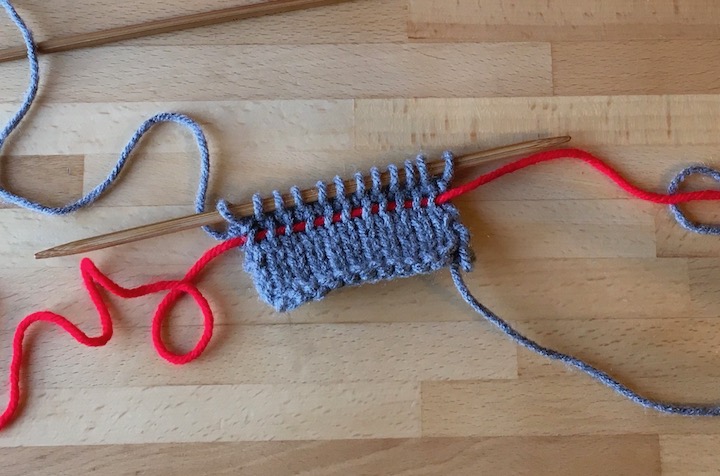
Sample of work after starting with the provisional cast on
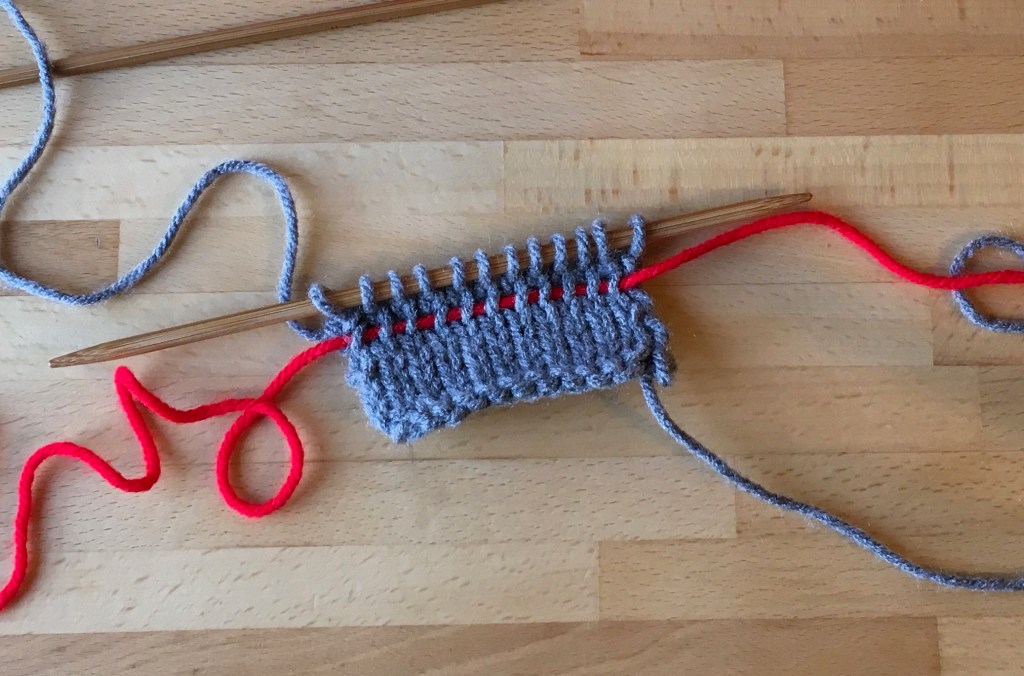
Seam made with provisional cast on and three needle bind off

The video below provides step by step instructions for how to do the provisional cast on. Check out the three needle bind off video for how to remove the scrap yarn, pick up the stitches, and join the ends of your work.

Want to Give it a Try?

The following patterns would all work well with the provisional cast on and three needle bind off:

Lesson 4 – Saving Your Work

In this lesson, you’ll learn how to make do some common repairs so when you make a mistake, you can fix it without having to go all the way back to the beginning. A crochet hook makes almost all of these repairs easier. Through the course of the following three videos, you’ll learn how to do all of the following:

Feel free to post a question in the comment section or drop me an email. Happy knitting!

Ready for more practice?

Check out all the available beginner knitting lessons.

How to Pick Up a Dropped Garter Stitch

Picking up a dropped stitch when knitting garter stitch is a little harder that picking up stitches in stockinette. Learn how in this step-by-step video. A crochet hook will make your repair job easier.

You might also be interested in the following post:

How to Rip Back, Pick up a Dropped Row, and Use Lifelines

This video covers how to get your work back on the needles if you lose a lot of stitches, how to tink, frog, and use lifelines to save your work if you have a problem in the middle. To tink (which is knit spelled backwards) is to unknit, one stitch at a time. To frog your work is when you pull out several rows; it’s called frogging because you “rip it, rip it.” A lifetime is a piece of scrap yarn that can be used to hold your stitches (as shown in the picture above) so if you make a mistake, you can rip back to the lifeline without losing your whole project. It’s particularly useful if you’re doing a complicated stitch that’s hard to pick up correctly if you need to go back. Check out the video below for how to use all of these techniques to save your knitting.

You might also be interested in the following posts:

How to Repair Common Knitting Mistakes

The video below shows how to pick up a dropped stitch and go back and fix a mistake in a previous row without having to rip back your work. A crochet hook makes repairs like this a lot easier. Check out the video below, as well as the other recommended posts, to learn how to fix comment knitting mistakes.

You might also be interested in these posts:

Lesson 3 – Knitting Easy Fingerless Gloves

In this lesson, you’ll knit a pair of easy fingerless gloves that introduce the purl stitch and ribbing. You can either work through the following in order to learn each of the steps required to knit the gloves, or you can jump straight to the pattern and tutorial video and come back to this page if you need more assistance with a particular step. Here are all the skills you’ll learn in this lesson:

You might also want to review the following:

Feel free to post a question in the comment section or drop me an email. Happy knitting!

Ready for more practice?

Make the matching Beginner’s Knit and Purl Hat! Or check out all the available beginner knitting lessons.

How to Tell if it was a Knit or Purl?

A common question from beginning knitters is how to tell if a stitch was a knit or purl?

  • If just below the loop on the needle, the yarn is horizontal, like a frown, that was a purl stitch.
  • If just below the loop on the needle, the yarn is more vertical and/or you can see a “V” shape, that was a knit stitch.

Check out this video to learn more.